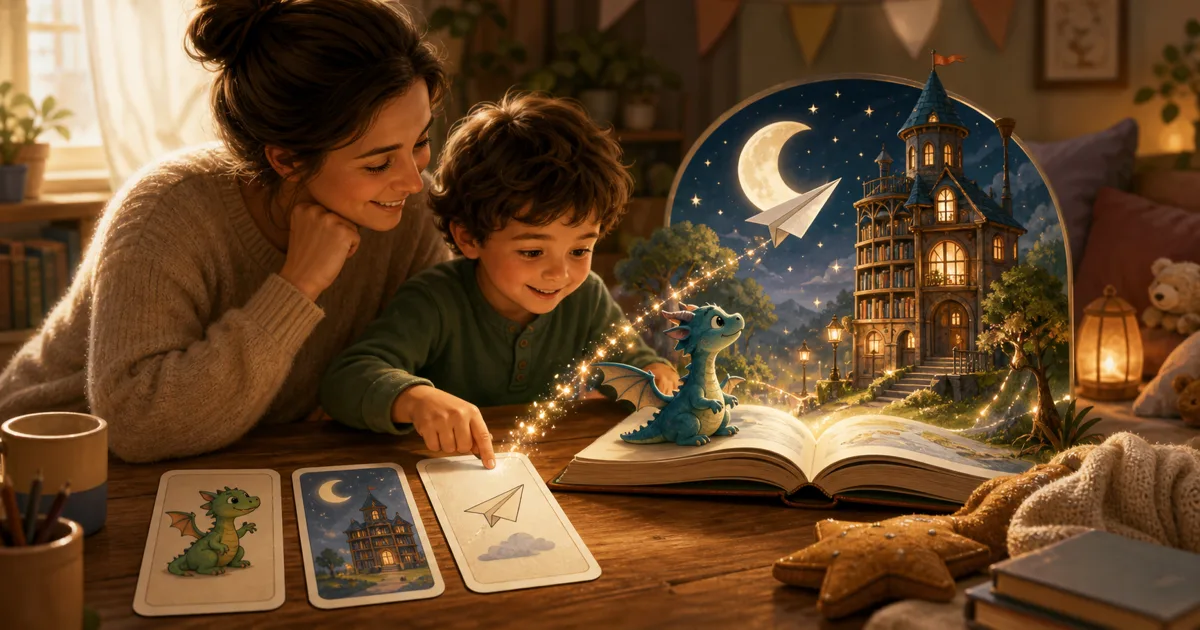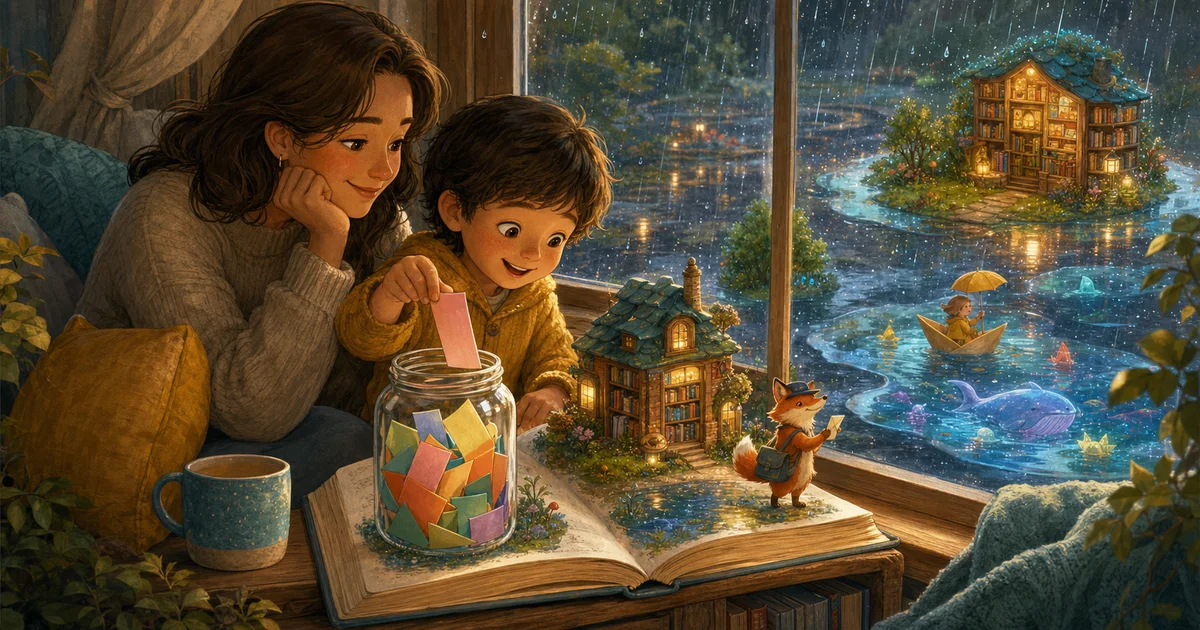
AI story generator examples for kids work best when they sound like something a child could actually say.
Not a perfect plot. Not a long instruction. Not a prompt that feels written for a machine.
Just a small idea with enough shape to become a story:
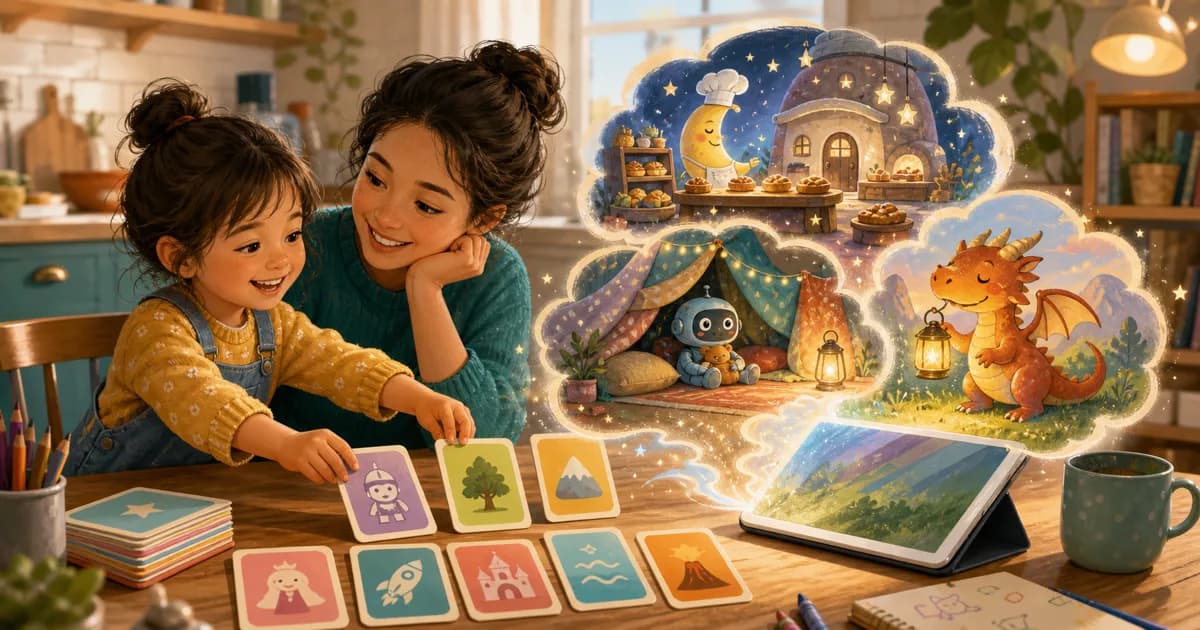
A character + a place + a tiny problem.
That is the pattern Storybox is built around. A child can speak a prompt out loud, Storybox can turn it into illustrated pages, and the family can read the finished story together.
This guide gives you practical prompt examples for bedtime, quiet time, travel, classrooms, and grandparents. You can use them inside Storybox or as old-fashioned story starters around the table.
If you want the trust-and-safety checklist first, read our AI story generator for kids parent guide. If you are still deciding what a story tool should do for your family, start with our broader story generator for kids guide. If you want a set of non-AI prompts, use storytelling prompts for kids.
Quick take
A good AI story generator prompt for kids should be:
- short enough for a child to say out loud
- specific enough to picture
- gentle enough for the moment
- open enough for the child to add one detail
- easy to read aloud when the story is finished
Try:
"A shy robot in a blanket fort who loses its bedtime button."
That prompt gives the story a character, setting, and problem. It also leaves room for your child to decide what the button does.
The simple prompt formula
Use three pieces.
| Piece | Parent question | Example |
|---|---|---|
| Character | Who is in the story? | A tiny dragon |
| Place | Where are they? | A moon bakery |
| Problem | What goes wrong? | The cupcakes float away |
Now say it as one sentence:
"A tiny dragon in a moon bakery whose cupcakes float away."
That is enough. If your child wants to add more, ask for one personal detail:
- What color is the dragon?
- What does the bakery smell like?
- Who helps catch the cupcakes?
- Should the story be sleepy, silly, or exciting?
One detail gives the story personality. Ten details can make the prompt harder to follow.
Bedtime AI story prompt examples
Bedtime prompts should usually move toward rest.
Try:
- A sleepy dragon delivering night-lights to every house
- A bunny who cannot find the moon's favorite blanket
- A teddy bear whose yawn gets stuck
- A tiny train bringing pajamas to the stars
- A cloud that wants someone to tuck it in
- A moon bakery that only makes dream cookies
- A polite monster learning how to whisper goodnight
- A pillow fort that turns into a quiet castle
- A pajama robot searching for its bedtime button
- A fox who follows fireflies to the softest tree
Ask one follow-up:
"What should help the character feel sleepy?"
That keeps the ending pointed in the right direction.
For more bedtime-specific ideas, use our bedtime story ideas for kids guide.
Funny prompts for younger kids
Younger kids often like prompts they can picture right away.
Try:
- A dinosaur who is very nervous about picture day
- A penguin who opens a pancake shop on a skateboard
- A cat who only wants to wear rain boots
- A robot who hiccups bubbles
- A turtle who finds a tiny castle in its lunchbox
- A unicorn whose horn keeps picking up radio stations
- A duck who thinks every puddle is a swimming pool
- A bear who politely asks a sandwich for directions
- A moon bunny who cannot stop sneezing stardust
- A puppy detective looking for the missing bedtime socks
Ask one small question:
"What is the funniest thing in the picture?"
Then let that answer become part of the story.
Travel and waiting-room prompts
Travel prompts should be short, because everyone is already managing bags, snacks, seatbelts, or waiting-room wiggles.
Try:
- A suitcase that tells jokes every time it opens
- A bus that accidentally drives to a cloud city
- A tiny astronaut waiting for pizza on Mars
- A backpack that keeps hiding snacks for later
- A train that only stops at silly stations
- A library book that gets homesick on vacation
- A sleepy airport cart looking for its best friend
- A map that gives directions in rhymes
- A whale who wants to visit the dentist
- A family car that finds a secret road made of pancakes
Ask:
"Should this story feel calm or silly?"
That helps the story match the moment. A waiting room may need gentle. A long drive may need funny.
Classroom and homeschool story prompts
For teachers and homeschooling families, prompts can support story structure without turning creativity into a worksheet.
Try:
- A classroom plant that writes notes at night
- A pencil that wants to become a detective
- A library where books trade endings
- A school bus that forgets which road is real
- A science fair volcano that only erupts glitter
- A lunchbox with a tiny weather system inside
- A chalkboard that draws tomorrow's weather
- A reading rug that becomes an island
- A ruler that measures kindness instead of inches
- A classroom dragon learning to raise its hand
Ask students to identify:
- character
- setting
- problem
- one possible ending
Then read the finished story aloud and ask what changed from the original prompt.
Grandparent-friendly prompts
Prompts for grandparents work best when they invite family details without requiring private information.
Try:
- A grandma whose cookie jar opens a door to the moon
- A grandpa whose toolbox fixes clouds
- A garden gnome who mails postcards to a child
- A rocking chair that remembers old stories
- A family dog who delivers bedtime letters
- A tiny train that brings birthday cake to every house
- A kitchen spoon that wants to join a marching band
- A blanket that remembers every sleepover
- A suitcase full of jokes from a family trip
- A treehouse that saves one seat for a grandparent
Ask:
"What real family detail should we borrow?"
Maybe it is cookies, a garden, a favorite chair, a pet, or a silly phrase. Small familiar details can make a story feel more personal.
If family sharing is your goal, read apps for grandparents and grandchildren to share stories.
Prompts for reluctant readers
When a child is reluctant to read, the prompt should give them a reason to care about the page.
Try:
- A character with the child's favorite animal
- A place based on a room they know
- A problem that sounds funny, not stressful
- A repeated word they can help read
- A favorite character returning for another story
Example prompts:
- A soccer-loving turtle who loses the team's lucky shoelace
- A bedroom castle where the pillows vote for a king
- A cat astronaut who forgets the moon password
- A tiny chef who makes soup for a dinosaur
- A superhero whose power is finding lost library cards
After the story is made, choose one small reading job:
- read the character name
- repeat a funny phrase
- point to a repeated word
- choose the best page to reread
Our guide to reading aloud with kids has a simple routine for keeping this warm instead of turning it into a test.
Prompts to avoid
Not every prompt belongs in a kids story generator.
For family story time, skip prompts that are:
- too scary for the child's age
- built around real private information
- mean-spirited toward a real person
- so complicated the child cannot follow them
- designed to keep generating forever instead of reading one story
Also be careful with prompts about worries, illness, safety, or big family changes. A gentle story can sometimes help a child talk, but an app should not replace a caring adult, teacher, pediatrician, or other trusted support when a child needs help.
How to use these examples in Storybox
Start small.
Choose one prompt from this article, or let your child swap one part:
"A tiny dragon in a moon bakery whose cupcakes float away."
Maybe your child changes the dragon to a penguin. Maybe the bakery becomes a submarine. Maybe the cupcakes become pancakes.
That is not a problem. That is the point.
Storybox can turn the spoken idea into illustrated pages. Then the important part starts: read the story together, ask one question, and decide whether this character should come back another day.
If you are still choosing the right tool, visit our AI story generator for kids page to see how Storybox keeps the loop focused on child-led prompts, finished stories, and family reading.