AI story prompts for kids work best when they leave room for the child.
That may sound backwards. A lot of AI prompts online are long, detailed, and written like instructions for a machine. They describe the style, the lesson, the ending, the mood, and every character before the story even begins.
For children, that can be too much.
The best prompt is usually small enough for a child to say out loud:
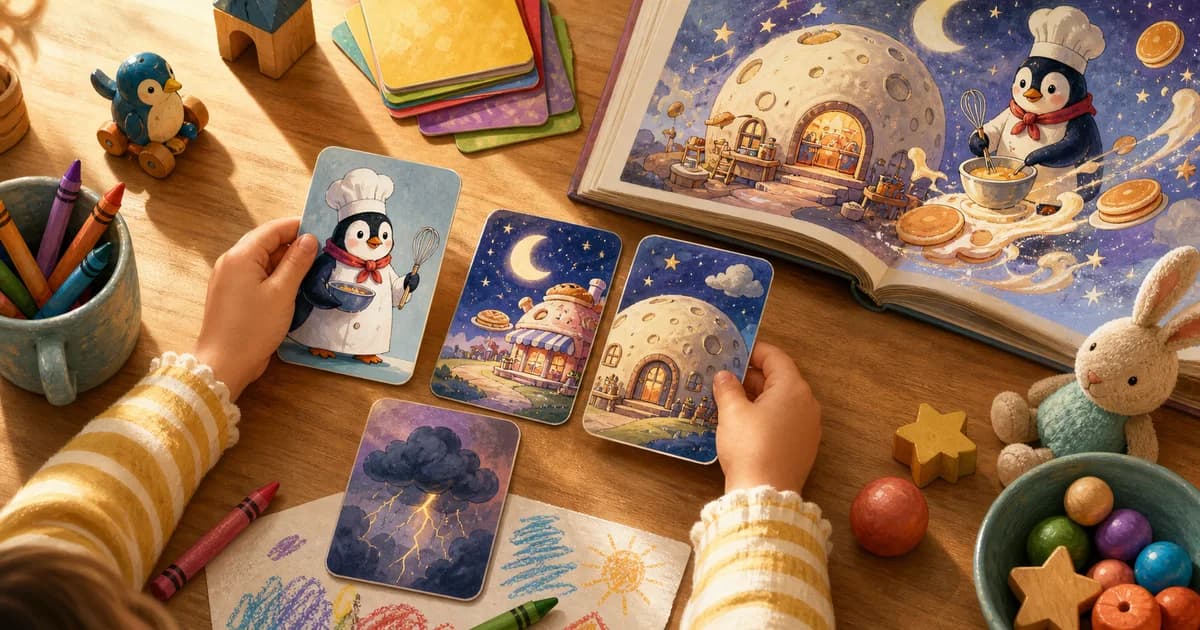
"A penguin in a pillow fort whose pancakes float away."
That is enough. It gives the story a character, a place, and a tiny problem. It also leaves space for the child to decide whether the penguin is brave, silly, sleepy, or very serious about breakfast.
Quick take
Use this formula:
A character + a place + a tiny problem.
Then ask one follow-up:
"What detail should be in the story because it came from you?"
That keeps an AI story prompt child-led instead of adult-controlled.
If you want more examples designed specifically for story tools, read AI story generator for kids: prompt examples parents can use. This post is the quick, scannable idea bank.
Why kids need smaller prompts than adults
Children are often full of story ideas, but a giant prompt can make them freeze.
If you ask, "What should the entire story be about?" the answer may be "I don't know."
If you ask, "Should the dragon live in a treehouse or a bakery?" the story suddenly has a doorway.
Small prompts help because they:
- are easy to say
- are easy to picture
- do not require spelling or typing
- leave space for surprise
- give the finished story a clear starting point
Storybox uses that same logic. A child can start with one spoken idea, then the app turns it into illustrated pages the family can read aloud.
The child-led prompt formula
Start with three pieces.
| Prompt piece | Parent question | Example |
|---|---|---|
| Character | Who is in the story? | A tiny dragon |
| Place | Where are they? | A moon bakery |
| Tiny problem | What goes wrong? | The cupcakes float away |
Then say it as one sentence:
"A tiny dragon in a moon bakery whose cupcakes float away."
If your child wants to add more, ask for one detail:
- What color is the dragon?
- What does the bakery smell like?
- Who helps catch the cupcakes?
- Is this story sleepy, silly, or exciting?
One detail makes the story personal. Ten details can make it harder to follow.
30 AI story prompts for kids
Use these in Storybox, around the dinner table, in a classroom, or anywhere your child wants a story starter.
Bedtime prompts
- A moon bunny in a blanket fort who loses the sleepy song
- A tiny train carrying pajamas to the stars
- A cloud gardener whose flowers only bloom after yawns
- A teddy bear who cannot find the quietest pillow
- A fox following fireflies to a soft tree
- A pajama robot whose bedtime button rolls away
For more nighttime ideas, use bedtime story prompts for kids.
Funny prompts
- A penguin chef whose pancakes float to the ceiling
- A turtle astronaut who packs soup for the moon
- A cat detective looking for missing rain boots
- A sandwich that politely asks for directions
- A dinosaur who is nervous about picture day
- A unicorn whose horn picks up radio stations
Creative confidence prompts
- A shy dragon who wants to tell one joke
- A robot learning how to ask for help
- A tiny knight who is brave enough to say "not yet"
- A bear who starts a library for nervous animals
- A moon mouse who builds a ladder one spoon at a time
- A fox who makes a map after getting lost
Keep these gentle. Stories can help kids play with feelings, but a story app should not replace a real grown-up conversation when a child needs support.
Family-detail prompts
- A family dog who finds a tiny door under the couch
- Grandma's cookie jar that opens into a moon kitchen
- A favorite blanket that becomes a map
- A stuffed bear who starts a bedtime band
- A backyard tree that remembers every birthday
- A lunchbox with a tiny weather system inside
Personal details make stories feel warmer, but avoid private information. A favorite pet, blanket, food, or family phrase is usually enough.
Classroom and homeschool prompts
- A pencil detective solving a mystery in the library
- A classroom plant writing notes at night
- A reading rug that becomes an island
- A science fair volcano that only erupts glitter
- A lunchbox that gives weather reports
- A school bus that forgets which road is real
Ask students to find the character, setting, problem, and ending after the story is created.
How to use one prompt in Storybox
Choose one prompt and let your child change one thing.
For example:
"A turtle astronaut who packs soup for the moon."
Ask:
- Should it be soup or pancakes?
- Is the turtle excited or nervous?
- Who should the turtle meet?
Then keep the final prompt short enough to say in one breath.
Storybox is a storytelling app for kids and AI story generator for kids built around that spoken idea. The point is not to write a perfect prompt. The point is to give your child a spark they recognize.
What to avoid in AI prompts for children
Skip prompts that are:
- too long for your child to remember
- too scary for the moment
- mean toward a real person
- built around private details
- designed to teach a lesson so heavily that the story stops feeling like a story
- focused on generating more and more instead of reading one finished story
The prompt should help the child start. It should not take over the whole experience.
A good prompt leads to a read-aloud
After the story is generated, do one simple thing:
Read it together.
Ask your child which part came from their idea. Point out a funny word. Choose a favorite picture. Decide whether this character should come back another day.
That is where AI story prompts become more than quick ideas on a screen. They become a way for a child to make something and hear it read back with a person they love.