Bedtime story prompts for kids should make the night easier, not bigger.
That is the whole trick.
At bedtime, a prompt does not need to launch an epic quest. It needs to give your child one small doorway into a story you can actually finish. The best prompts are easy to picture, gentle enough for a sleepy room, and flexible enough for your child to add one detail.
This guide is more tactical than our broader list of bedtime story ideas for kids. Use that post when you want lots of finished ideas. Use this one when you want a repeatable prompt formula you can use tonight, tomorrow, and the next night too.
Quick take
Use this bedtime prompt formula:
A character + a cozy place + a tiny problem + a soft ending question.
Example:
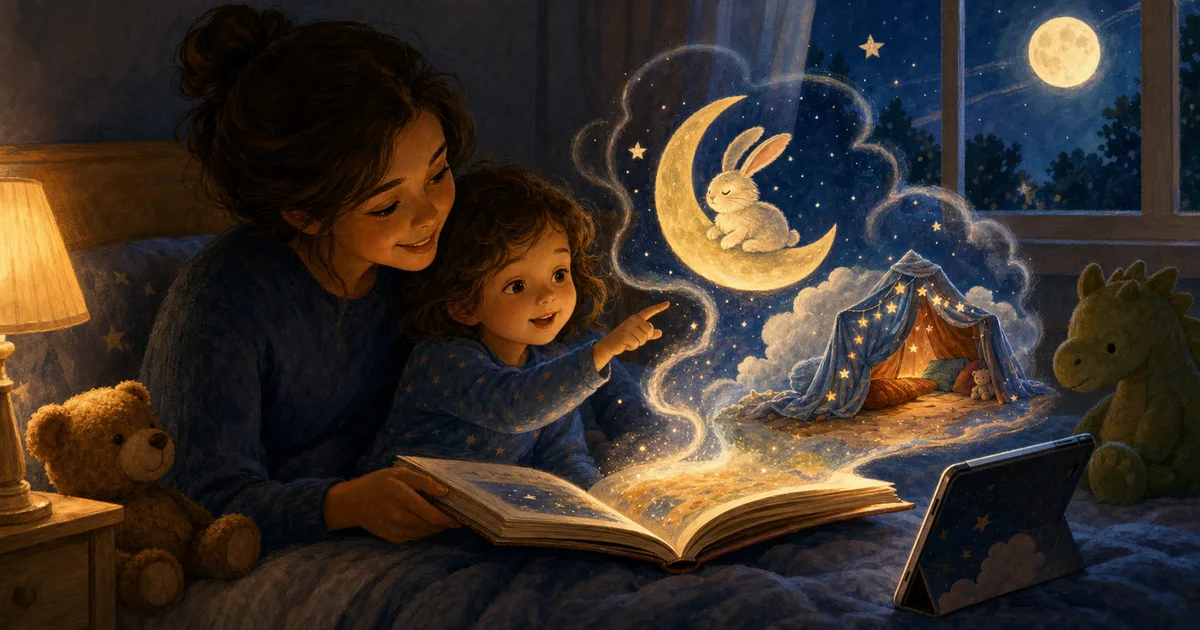
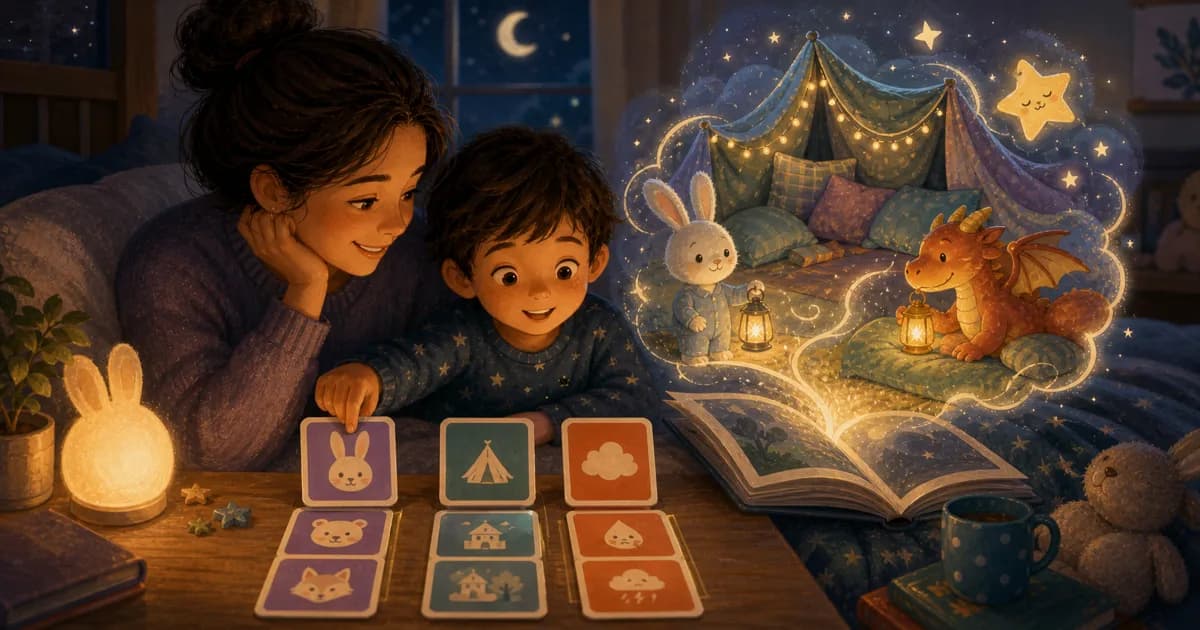
"A moon bunny in a blanket fort who cannot find the sleepy song."
Then ask:
"What helps the bunny feel ready for bed?"
That question points the story toward rest instead of turning it into a chase, battle, or brand-new negotiation.
Why bedtime prompts need to be smaller
Tired children can still have enormous imaginations.
That is wonderful at 4 p.m. It can be harder at 8 p.m.
A prompt like "a dragon adventure" might turn into volcanoes, villains, lost treasure, rocket ships, and three more chapters. A prompt like "a sleepy dragon looking for a night-light" gives the story a clearer job.
It still has magic. It just knows where it is going.
Reading Rockets encourages families to read aloud often and make reading interactive. For bedtime, the interactive part can stay small: one choice, one question, one favorite page. You do not need to turn the story into a lesson plan.
The bedtime prompt formula
Start with four pieces.
| Piece | What to choose | Example |
|---|---|---|
| Character | Someone easy to imagine | A tiny dragon |
| Cozy place | Somewhere safe or soft | A blanket fort |
| Tiny problem | Something solvable | The night-light is missing |
| Soft ending question | A way back to rest | What helps them feel sleepy? |
Now put the first three pieces together:
"A tiny dragon in a blanket fort whose night-light is missing."
Then keep the ending question ready:
"What helps the dragon feel safe enough to sleep?"
That question gives your child a way to help the character. It also keeps the story emotionally small.
Character prompts for bedtime
Pick a character your child can picture quickly.
Try:
- A moon bunny
- A tiny dragon
- A pajama robot
- A polite bear
- A sleepy fox
- A cloud sailor
- A teddy bear
- A blanket monster
- A star gardener
- A whispering train
If your child wants to personalize the story, ask:
"What is their name?"
Stop there if the room is already tired. One name can be enough.
Cozy place prompts
The place should feel safe, even if it is imaginary.
Try:
- A blanket fort
- A moon bakery
- A pillow mountain
- A tree library
- A star dock
- A bedroom castle
- A quiet train
- A cloud garden
- A pajama parade
- A tiny house inside a book
Ask:
"What is the softest thing there?"
That usually leads to pillows, blankets, clouds, warm lights, or stuffed animals. Those are bedtime-friendly details.
Tiny problem prompts
Tiny problems are better than giant danger.
Try:
- The night-light is missing
- The sleepy song got lost
- The pillows keep floating away
- The moon forgot its blanket
- The teddy bear cannot yawn
- The stars are whispering too loudly
- The pajamas only speak in rhymes
- The cloud cannot find a place to rest
- The bedtime cookie rolled under the bed
- The train forgot which stop is Dream Station
Avoid problems that raise the energy too much, like monsters chasing, getting trapped, or racing against a disaster. Some children love those stories, but bedtime usually needs a gentler shape.
Soft ending questions
The ending question is the part parents forget.
It matters because it tells the story where to land.
Try:
- What helps them feel sleepy?
- Who brings the missing blanket?
- Where is the quietest place to sit?
- What soft sound do they hear?
- Which friend says goodnight?
- What tiny light helps them find the way?
- What do they want to remember tomorrow?
- How does the room become cozy again?
These questions still let your child participate. They just do not open five new doors at once.
Complete bedtime story prompts
Here are prompts you can use as-is.
- A moon bunny in a blanket fort who cannot find the sleepy song
- A tiny dragon in a tree library whose night-light keeps floating away
- A pajama robot in a bedroom castle who only speaks in whispers
- A polite bear on pillow mountain who cannot stop saying goodnight
- A sleepy fox at the star dock waiting for one soft dream
- A cloud sailor in a moon bakery whose cookies keep drifting into the sky
- A teddy bear in a quiet train who forgets which stop is bedtime
- A blanket monster in a tiny house inside a book who needs a friend
- A star gardener in a cloud garden whose flowers only bloom after yawns
- A whispering train carrying pajamas to every sleepy house
If you are using Storybox, your child can say one of these out loud. Then read the finished story together and ask the soft ending question at the last page.
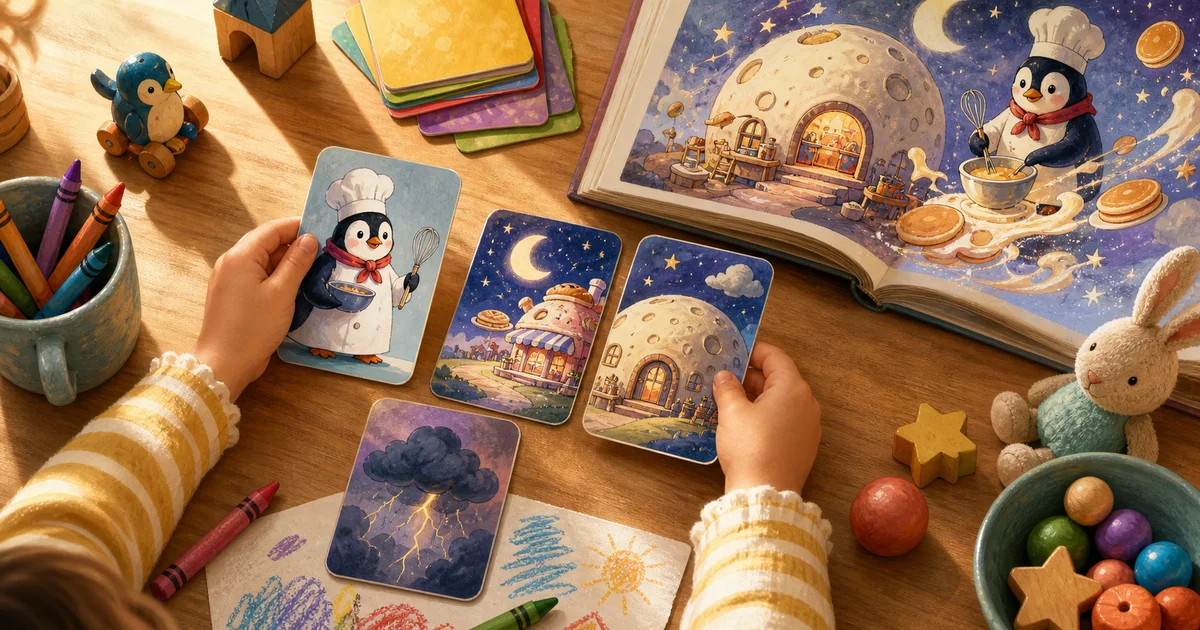
Prompt cards you can make in five minutes
You do not need a printable or a craft project.
Use scraps of paper.
Make three piles:
- Character
- Cozy place
- Tiny problem
Write five cards for each pile.
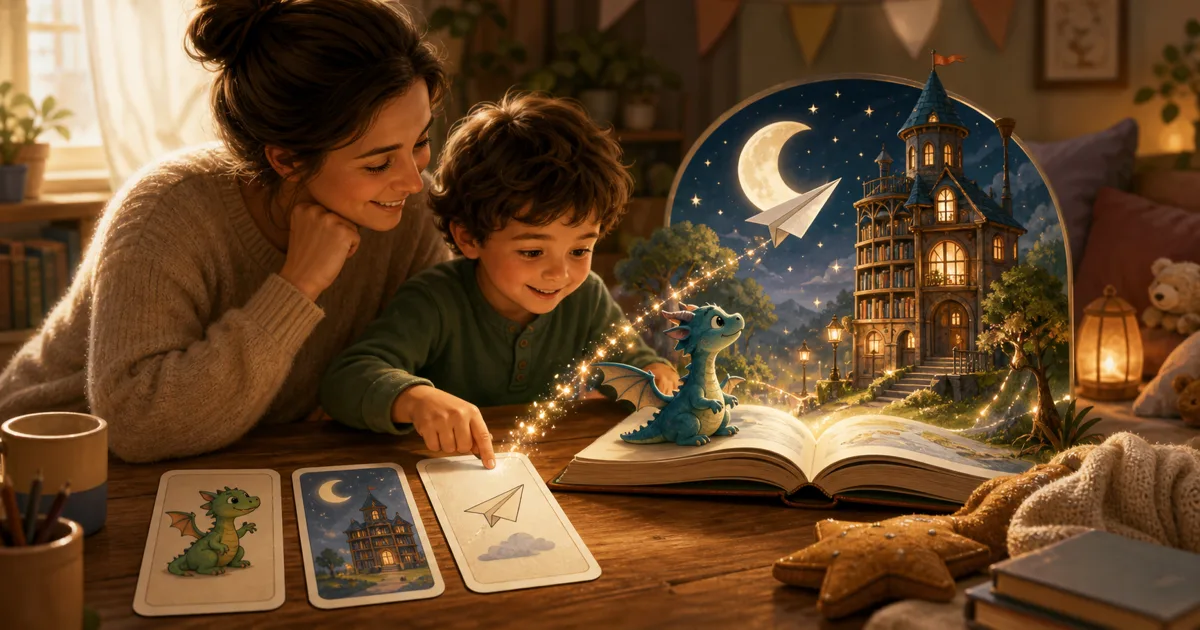
Then pull one from each pile at bedtime.
For example:
| Character | Cozy place | Tiny problem |
|---|---|---|
| Moon bunny | Blanket fort | Lost the sleepy song |
| Tiny dragon | Tree library | Night-light floated away |
| Pajama robot | Bedroom castle | Only speaks in whispers |
| Polite bear | Pillow mountain | Cannot stop saying goodnight |
| Cloud sailor | Star dock | Needs one soft dream |
Let your child swap one card if they want. One swap gives them ownership. Three swaps can become bedtime politics.
Picture-first prompts for quiet nights
Some children answer picture questions more easily than plot questions.
Instead of asking what happens next, ask what the first page should show:
- a sleepy star above a blanket fort
- a tiny dragon carrying one warm lantern
- a bunny holding a map of the moon
- a pillow mountain with a secret door
- a train window glowing in the dark
Then turn that picture into a prompt. The story can begin with what your child can already see.
How to use bedtime prompts in Storybox
Storybox works well when the prompt is short enough for your child to say in one breath.
Good:
"A moon bunny in a blanket fort who lost the sleepy song."
Too much:
"A moon bunny who lives in a blanket fort with three cousins and a magic suitcase and they go to a planet where the moon is broken and then a wizard..."
The second prompt might be fun another time. At bedtime, the first one is kinder.
After Storybox creates the illustrated story, read it like a bedtime book:
- Read the first page aloud.
- Ask which detail came from your child.
- Keep moving toward the ending.
- Save the story if it feels like one worth repeating.
If you want more on reading the finished story together, see reading aloud with kids.
When a prompt gets too exciting
Sometimes the story takes off anyway.
Your child adds a dragon race, a secret portal, or a giant cake explosion. That is not bad. It means the idea worked.
To bring it back down, try one line:
- "Then the adventure got quieter."
- "They found a soft place to rest."
- "The character remembered the bedtime plan."
- "The problem was smaller than it looked."
- "Everyone heard a gentle goodnight sound."
Then ask:
"What helps the character settle?"
You are not shutting down imagination. You are giving it a bedtime lane.
A simple routine for tonight
Before pajamas, ask your child to choose:
- one character
- one cozy place
- one tiny problem
After pajamas, read the story.
At the end, ask:
"What part should we remember tomorrow?"
That gives your child a thread to carry into sleep. It also gives you tomorrow's prompt, which may be the most useful bedtime gift of all.