Bedtime story ideas for kids disappear at the exact moment you need them.
At breakfast, your child can invent twelve dragons, a talking umbrella, and a castle made of noodles. At bedtime, when the lights are low and you ask what tonight's story should be about, everyone suddenly forgets how imagination works.
That is normal. Tired brains do not love blank pages.
Here are 45 gentle bedtime story ideas for kids you can use with Storybox or on your own when the story well is dry. Pick one small character, one cozy place, and one tiny problem, then let your child add a detail before you read.
If you want a broader story-making pattern before bedtime, start with our simple formula for creating your own stories with kids.
If your child loves stories that include their own ideas, our guide to personalized bedtime stories for kids explains how small familiar details can make bedtime reading feel easier.
If you want a repeatable formula instead of a long list, use our bedtime story prompts for kids guide.
If you are looking for a voice-first tool that turns one of these ideas into a finished story, see the AI bedtime story app page.
Quick take
The easiest bedtime prompts are small, cozy, and a little funny.
Try:
A character + a soft place + a tiny problem.
At bedtime, tiny problems are better than giant quests.
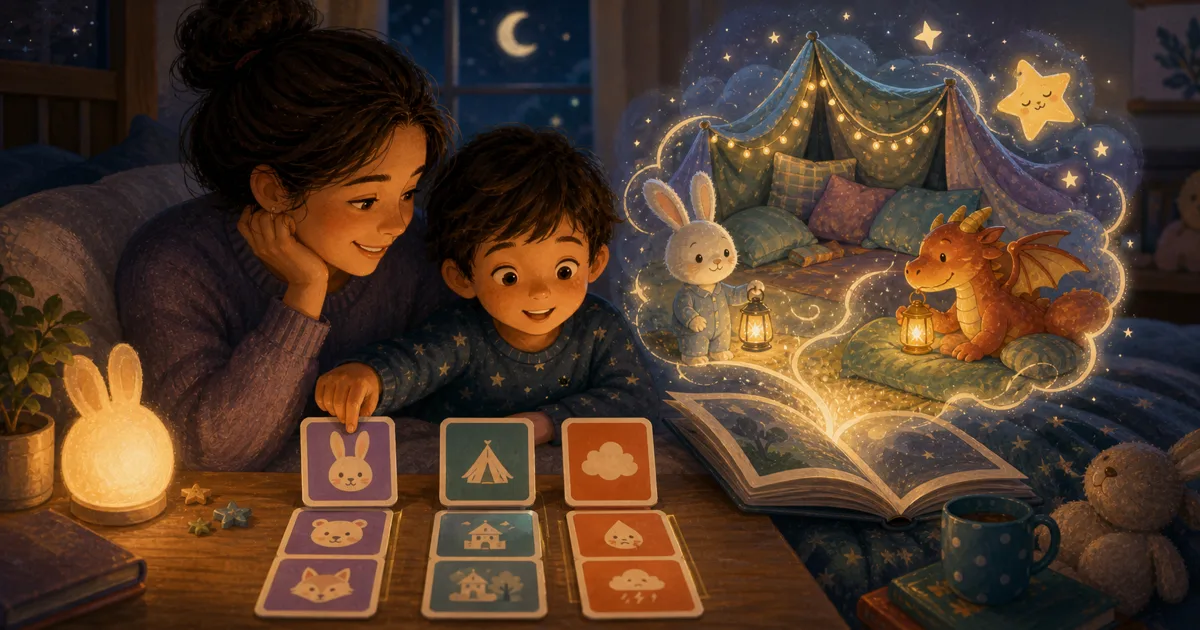
The best bedtime story ideas for kids are easy to picture, easy to answer, and easy to finish. A prompt like "a sleepy dragon looking for a night-light" works because your child can add one detail without needing to invent a whole plot. That keeps the story playful without making bedtime feel wide awake again.
Five short bedtime story ideas for tired nights
When everyone is ready for sleep, short bedtime story ideas for kids can be easier to start than a big adventure. Here are five especially quick picks from the list below. Try one exactly as it is, or let your child add one small detail:
- A moon bunny who cannot find the sleepy song.
- A tiny train that brings pajamas to every house.
- A bear who opens a blanket shop in the forest.
- A cloud that wants to be tucked in.
- A night-light that is afraid of the dark.
Each one already has a character, a cozy place, and a tiny problem, so you can begin reading instead of spending ten minutes choosing. For more ways to make story time feel smaller on busy evenings, see our guide to making bedtime stories easier.
Picture-first bedtime story prompts
Some children do not start with a plot. They start with a picture in their head.
That is a useful way to make bedtime story prompts feel easier. Instead of asking "what should happen?", ask your child to describe one cozy picture: a character, a soft place, and one detail they can point to.
Try these picture-first bedtime story prompts:
- A tiny dragon carrying night-lights through a blue forest
- A bunny reading a moon map inside a blanket fort
- A teddy bear opening a sleepy-song library
- A cloud sailor delivering one soft dream to a bedroom window
- A pajama robot building a pillow castle with a quiet flag
If you use Storybox, your child can say one of these ideas out loud and then add a personal detail, like a favorite color, pet name, or grandparent's house. If you are making up the story without an app, use the picture as the first page and ask: "What is the smallest problem here?"
How to pick a bedtime story idea
Start by matching the prompt to the kind of night you are having.
If your child is calm, you can use a slightly longer idea with a small adventure. If everyone is tired, choose a prompt that already points toward rest. If your child is anxious, use familiar places and gentle problems instead of big quests or surprises.
A bedtime-friendly idea usually has three parts:
| Part | What to choose | Example |
|---|---|---|
| Character | Someone easy to imagine | A sleepy dragon |
| Soft place | Somewhere safe or cozy | A blanket fort |
| Tiny problem | Something solvable | The pillows keep floating away |
That gives you a story starter, not a homework assignment.
Try saying:
"Tonight's story is about a sleepy dragon in a blanket fort whose pillows keep floating away."
Then ask just one question:
"What color is the dragon's favorite pillow?"
That one detail gives your child ownership. You do not need five follow-up questions. At bedtime, less is usually kinder.
Bedtime story ideas by age
Different ages need different kinds of prompts. The story can still be simple, but the question you ask changes.
Ages 3 to 5: picture-first prompts
Younger children often respond best to concrete things they can see in their head.
Try:
- A moon bunny who cannot find the sleepy song
- A tiny train that brings pajamas to every house
- A bear who opens a blanket shop in the forest
- A duck who wants the stars to whisper more quietly
- A teddy bear who learns how to yawn
Ask one picture question:
"What is the bear carrying?"
Ages 6 to 8: choice-and-problem prompts
Early elementary kids often enjoy solving a funny problem.
Try:
- A robot who has to deliver one bedtime cookie to the moon
- A wizard whose magic wand only makes slippers
- A pirate who is looking for the world's softest pillow
- A fox who finds a map to the quietest tree
- A cloud that wants to be tucked in
Ask one problem question:
"How should they fix it?"
Ages 9 and up: twist prompts
Older kids may want a little more surprise, but bedtime still works best when the stakes stay gentle.
Try:
- A library where every book dreams about its reader
- A lighthouse that only shines for lost lullabies
- A city where everyone trades dreams in tiny jars
- A clock that tries to slow down bedtime for one more page
- A child who discovers tomorrow's story under the pillow
Ask one twist question:
"What is the rule in this world?"
Cozy animal story ideas
Animal stories work because children can picture them quickly.
Try:
- A bunny who cannot find the moon's favorite blanket
- A bear who opens a tiny library inside a tree
- A fox who follows fireflies to a sleepy parade
- A penguin who makes soup for the stars
- A turtle who builds a pillow fort on the beach
If your child wants to help, ask one small question:
"What color is the blanket?"
That gives them ownership without waking the whole room back up.
More cozy animal ideas:
- A kitten who opens a midnight tea party for tired toys
- A hedgehog who knits a scarf for the wind
- A puppy who finds a secret stairway inside a pillow
- A whale who hums lullabies to ships
- A pajama mouse who returns every lost slipper before morning
Gentle adventure ideas
Adventure does not need to mean danger.
For bedtime, keep the adventure soft:
- A train that only stops at dream stations
- A sailboat that carries letters to the moon
- A tiny astronaut looking for the quietest planet
- A cloud that wants to learn a lullaby
- A sleepy dragon delivering night-lights to the forest
These prompts still move, but they move toward rest.
More gentle adventure ideas:
- A wagon that rolls only when someone whispers a story
- A tiny camper looking for the perfect marshmallow cloud
- A child and a teddy bear sailing across a blanket ocean
- A lantern that leads every tired traveler home
- A mailbox that delivers dreams instead of letters
Funny bedtime problems
A little silliness can help a child relax.
Try problems like:
- The pillows keep floating away
- The moon forgot where it parked
- The pajamas only speak in whispers
- A teddy bear is too polite to yawn
- The stars are having a hiccup contest
Small funny problems are useful because they do not need a complicated solution. They give the story a shape and let everyone smile before sleep.
More funny bedtime problems:
- The toothbrush keeps telling knock-knock jokes
- The blanket wants to be a superhero cape
- The night-light is afraid of the dark
- The teddy bears are practicing a very quiet parade
- The moon has the hiccups and needs a glass of water
Calm story ideas for anxious nights
Some nights need extra softness.
When a child feels worried, skip prompts about getting lost, racing, danger, or big surprises. Choose a familiar helper, a safe place, and a problem that ends with comfort.
Try:
- A favorite stuffed animal checks every corner and finds only cozy things
- A small boat follows a warm light back to shore
- A blanket fort gets stronger every time someone takes a slow breath
- A child plants a worry in the garden and it grows into a flower
- A sleepy star waits outside the window until everyone feels ready
These stories do not have to explain the worry directly. Sometimes the safest bedtime story is one where the world simply becomes manageable again.
Grandparent-friendly bedtime ideas
If a grandparent or long-distance family member is reading, use prompts that invite familiar memories.
Try:
- A cookie from Grandma's kitchen that knows a bedtime song
- A suitcase that remembers every family trip
- A garden gnome who writes letters to the moon
- A rocking chair that tells a story about when it was young
- A grandparent and child who find a tiny door behind a bookshelf
These prompts work well because they give the reader something personal to add. A grandparent can change the kitchen, garden, chair, or trip to match a real memory.
How to use these in Storybox
Pick one idea and let your child add one detail.
For example:
"A sleepy dragon delivering night-lights to the forest."
Then ask:
"What is the dragon carrying them in?"
Maybe it is a backpack. Maybe it is a teacup. Maybe it is a wagon pulled by two snails.
That final child-made detail is what makes the story feel personal. Storybox can turn the spoken prompt into an illustrated story your family can read together.
For families choosing a digital tool for this, our personalized bedtime stories page and AI story generator for kids guide explain what to look for when the goal is still reading together. If your child needs something small to do while a story is being made, our note on positive screen time while kids wait explains how to keep the moment bounded.
Turn one prompt into a Storybox story
If you are using Storybox, keep the spoken prompt short enough that your child can remember it.
Good Storybox bedtime prompts sound like:
- "A moon bunny who loses the sleepy song."
- "A tiny dragon who delivers night-lights."
- "A teddy bear whose yawn gets stuck."
- "A blanket fort that becomes a quiet castle."
- "A puppy who finds the softest cloud."
Then add one personal detail:
- A pet's name
- A favorite color
- A familiar room
- A grandparent's house
- A favorite snack
For example:
"A tiny dragon named Pip delivers night-lights to Grandma's house."
That is enough. Storybox can shape the idea into illustrated pages, and your family can read the finished story aloud instead of staying stuck in idea-making mode.
If your child wants another one immediately, save the favorite first. Rereading a story they helped make is often better for bedtime than generating five new ones.
Keep a bedtime story jar
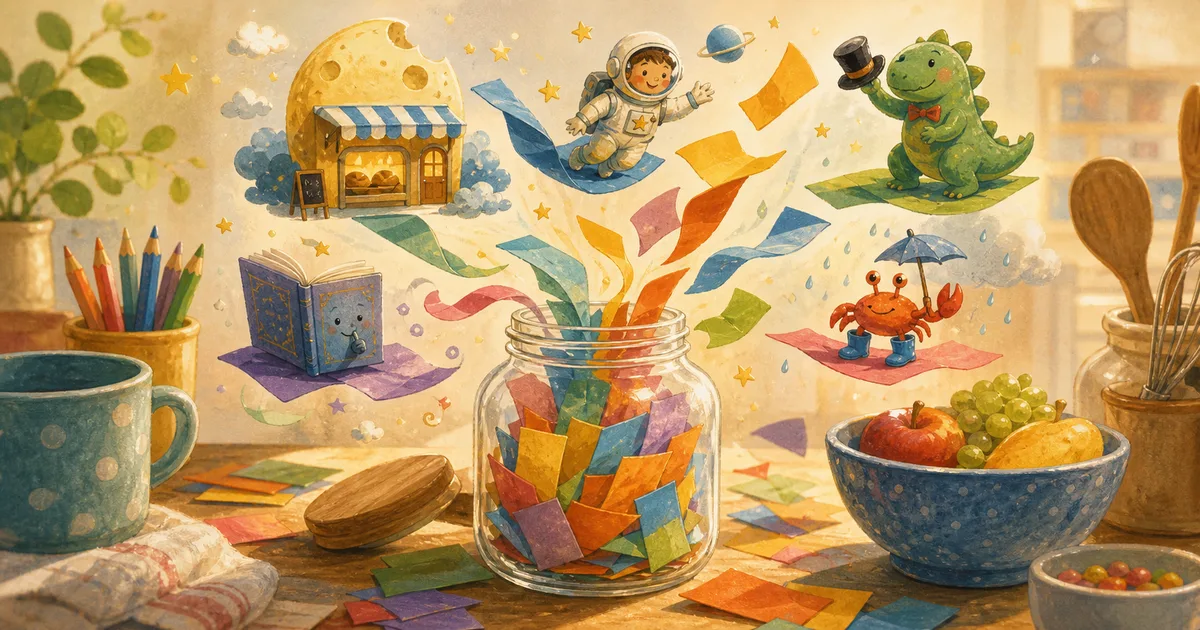
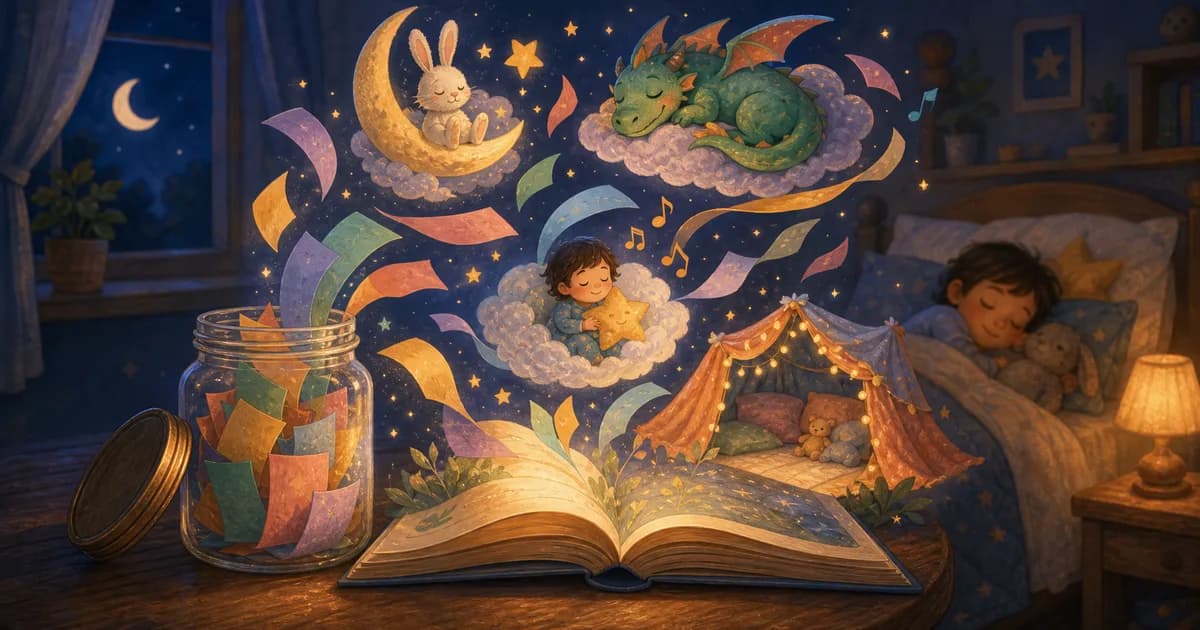
Write a few characters, places, and tiny problems on scraps of paper. Keep them in a jar near the bed.
When nobody has an idea, pull one from each group:
- Character: moon bunny
- Place: blanket fort
- Problem: lost a sleepy song
Now you have a story.
Not a perfect one. A usable one.
That is what bedtime needs most.
Here is a quick set to start with:
| Characters | Places | Tiny problems |
|---|---|---|
| Moon bunny | Blanket fort | Lost a sleepy song |
| Tiny dragon | Tree library | Forgot where the night-light goes |
| Polite bear | Pillow mountain | Cannot stop saying goodnight |
| Cloud sailor | Star dock | Needs to deliver one soft dream |
| Pajama robot | Bedroom castle | Only speaks in whispers |
Pull one from each column, then let your child swap one piece if they want to. That keeps the prompt flexible without turning bedtime into a negotiation.
When the story gets too exciting
Sometimes a bedtime story starts cozy and becomes a rocket launch, a chase, or a monster battle. That is not a failure. It just means your child found energy inside the idea.
To bring the story back down, use one of these lines:
- "Then everyone heard a soft sound in the distance."
- "The character remembered it was almost time to rest."
- "They found a warm place to sit and think."
- "The adventure became quieter with every step."
- "The problem was smaller than it looked."
You can also ask:
"What would help them feel sleepy again?"
That lets your child guide the ending while still moving the story toward rest.
A softer way to end
When the story is done, ask one quiet question:
"Which part should we remember tomorrow?"
That gives your child a tiny thread to carry into sleep. It also gives you tomorrow's prompt, which is a gift for the next tired night.
The goal is not to invent the best bedtime story idea in the world. The goal is to make tonight's story easy to begin, gentle to finish, and personal enough that your child wants to hear it again.