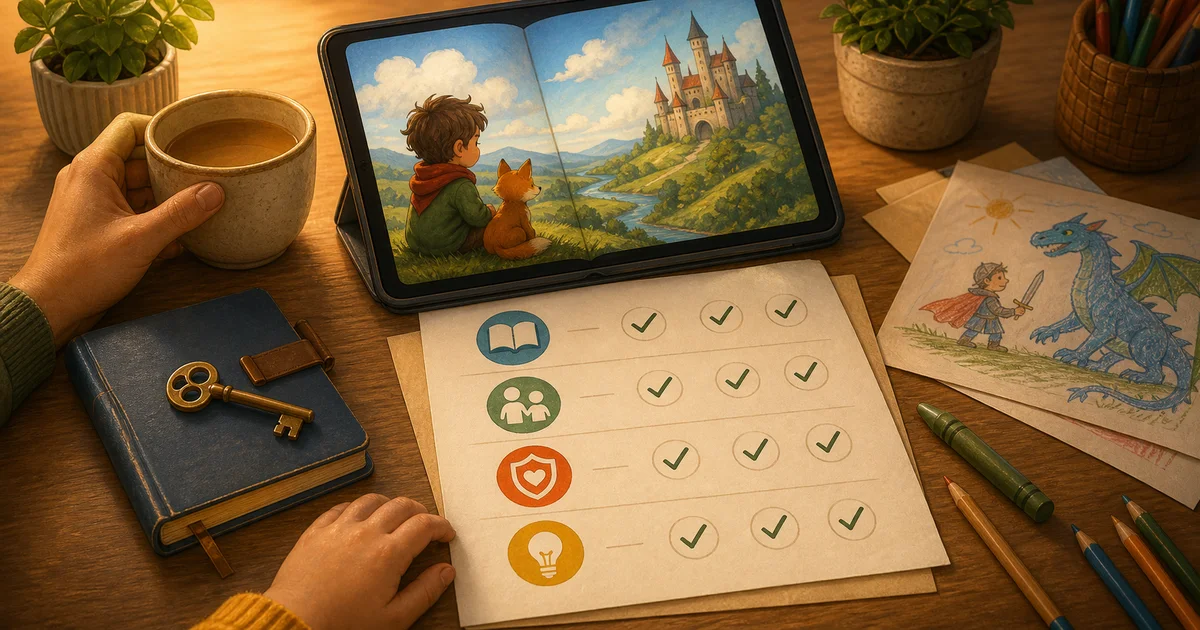
Reading aloud with kids does not need to be a perfect story hour.
Some nights, it is one page. Some afternoons, it is a child interrupting every third sentence to explain what the character should have done. Sometimes the story begins on paper. Sometimes it begins with a spoken idea inside Storybox and becomes an illustrated page you read together.
The useful part is the together part.
When a grown-up voice, a child's idea, and a story page meet in the same moment, reading can feel less like a task and more like a conversation. That is the rhythm this guide is about.
If you are choosing digital tools for story time, start with our guide to reading apps for kids that still feel like reading. If your child is building confidence with words, our note on helping kids learn to read without homework energy pairs well with this routine.
Quick take
Reading aloud works best when it feels warm, short, and shared.
Try this rhythm:
- Read the page first so the story keeps moving.
- Invite your child to read or repeat one tiny piece.
- Ask one question about meaning, not performance.
- Let the story end before everyone is worn out.
Storybox can support that rhythm because the story begins with your child's prompt, then turns into pages you can read aloud together.
Why reading aloud still matters
Children do not only hear words when we read aloud. They hear pacing, expression, surprise, comfort, and how a sentence can carry a feeling.
Reading Rockets describes reading aloud as one of the most important things parents and teachers can do with children. It can introduce richer language, invite conversation, and make books feel like part of family life.
That does not mean every read-aloud moment has to be long. A tired child may only have room for a few pages. A grown-up may only have ten minutes. The point is not to perform a flawless routine. The point is to keep giving reading a friendly shape.
Storybox is useful here because a child-made story often gives everyone an easy reason to care. If your child asked for "a shy dragon who opens a pancake stand on the moon," they already have a stake in the first page.
Start with the child's idea
Some children freeze when you ask, "What do you want to read?"
That question is bigger than it sounds. It asks them to choose a mood, a topic, a length, and sometimes a whole shelf.
A smaller question works better:
- "Who should be in tonight's story?"
- "Where should the story happen?"
- "What tiny problem should the character have?"
Inside Storybox, that might become a spoken prompt:
"A shy dragon opens a pancake stand on the moon."
Outside the app, it can become the first sentence of a made-up story.
The important part is ownership. When a child helps create the story, the read-aloud is not just something happening to them. It is something they helped begin.
Use a three-pass read
If your child is learning to read, it is easy for read-aloud time to turn into correction time.
Try a three-pass read instead.
| Pass | What the grown-up does | What the child does |
|---|---|---|
| First | Reads the page with expression | Listens and follows the picture |
| Second | Points to one friendly word or phrase | Tries that small piece |
| Third | Rereads the page smoothly | Joins in where they want |
This keeps the story from stopping at every hard word. It also gives your child a supported place to try.
You can make the child piece very small:
- One repeated word
- One funny sound
- One character name
- One short sentence
- One line they choose because they like it
One successful moment is better than five minutes of pressure.
Ask questions that keep meaning alive
The best read-aloud questions do not sound like a quiz.
Instead of:
"What word is this?"
Try:
- "What do you think the character wants?"
- "Which picture detail should we notice?"
- "What would you say if you were there?"
- "Should this character come back in another story?"
- "What part should we remember tomorrow?"
These questions keep attention on the story. They also give a child room to talk, point, laugh, disagree, or invent.
That matters with app-created stories too. The screen should not swallow the conversation. A finished Storybox story gives you something to read, but the human part still happens around the page.
Make shared screen time actually shared
Many parents are trying to be realistic about screens.
Sometimes a screen is part of the day. The better question is what job the screen is doing.
HealthyChildren.org, the American Academy of Pediatrics' parent site, encourages families to make media plans that fit their values and routines. Its guidance on co-viewing media with your child points toward a useful idea: children can get more from media when adults are present to talk, guide, and connect the experience to real life.
For Storybox, that means the app should not be the whole activity.
Try this:
- Let your child speak the story idea.
- Watch the story become pages.
- Put the device where both of you can see it.
- Read the first page aloud.
- Ask one question before moving on.
Now the screen is a story surface, not a babysitter.
If you are thinking about this from the screen-time side, our guide to positive screen time for kids has a practical framework.
Keep bedtime read-alouds small
Bedtime is not the time for a complicated reading plan.
Use a smaller goal:
Read one finished story, or one favorite part of a finished story.
That is enough.
If your child wants to create a new Storybox story at bedtime, keep the prompt gentle:
- A sleepy dragon looking for a night-light
- A bunny who cannot find the moon's blanket
- A teddy bear whose yawn gets stuck
- A tiny train delivering pajamas
- A cloud that wants to be tucked in
Then read the finished story with a soft ending in mind. You can find more ideas in our bedtime story ideas for kids guide.
Let grandparents read too
Reading aloud does not have to live only in one house.
If a child creates a story they are proud of, sharing it with a grandparent can give the next call a clear starting point. Instead of "What did you do today?", the question becomes, "Can you show me the dragon bakery?"
That is easier for many kids.
Parents can share saved Storybox stories with trusted family members through a reading link. A grandparent can read a page, ask what part came from the child, and choose one idea for the next story.
For more on that routine, see apps for grandparents and grandchildren to share stories and sharing kids' stories with grandparents.
A five-minute routine to try tonight
Here is a simple read-aloud routine you can use with a Storybox story or any short book.
Minute 1: choose the story
Let your child pick the story or speak a tiny prompt.
Minute 2: read the first page
Read it with expression. Do not stop for every word.
Minute 3: invite one small try
Ask your child to read a repeated word, say a character name, or echo a funny phrase.
Minute 4: ask one meaning question
Try: "What does the character want now?"
Minute 5: close the loop
Ask: "Should we save this one for another night?"
That is a complete reading moment. It has a beginning, a shared middle, and an ending.
When your child does not want to read aloud
Some children do not want to perform.
That is okay.
They can still participate by:
- Choosing the character
- Pointing to a picture detail
- Predicting the next page
- Repeating one silly sound
- Deciding whether to save the story
Reading aloud with kids is not only about getting a child to say words correctly. It is about helping stories feel worth returning to.
Some days, listening is participation.
How Storybox fits
Storybox is a kids story app built around child-led ideas and family reading. A child can speak a prompt, Storybox can turn it into illustrated pages, and a grown-up can bring the story to life with their voice.
That is the part we care about most.
The app starts the story.
The read-aloud makes it yours.