AI bedtime stories for kids can sound like exactly what a tired parent needs.
It is late. Your child wants one more story. You have already read the favorite book three times this week, and your brain is not offering anything new beyond "a bear went to bed."
That is a real parenting moment, not a failure.
The useful question is not whether AI belongs anywhere near bedtime. The better question is: does this tool help your child wind down and read with you, or does it turn bedtime into more scrolling?
Storybox is built for the first version. A child shares a short idea with just their voice, the app turns it into an illustrated story, and the family comes back to the part that matters most at night: reading together.
The short version
AI bedtime stories can be helpful when they:
- start with your child's idea
- stay short enough to finish
- have a natural ending
- lead back to reading aloud
- avoid turning one story into an endless feed
They work best as a story starter, not as a bedtime replacement.
If you are choosing a broader story tool, start with our AI story generator for kids parent guide or the AI story generator for kids page.
Why parents search for AI bedtime stories
Most parents are not searching for AI bedtime stories because they want bedtime to become more complicated.
They are usually trying to solve one of these problems:
- their child wants a new story every night
- bedtime needs to feel special without becoming longer
- a child has an idea but needs help turning it into a story
- the grown-up is tired and out of fresh plots
- the family wants something creative that still has an ending
That is a reasonable use case. Bedtime is full of tiny negotiations, and a story can help the room soften.
The risk is when the tool keeps asking for more attention after the story is done. Bedtime does not need an infinite content machine. It needs one story that can land.
What makes an AI bedtime story feel calm
A bedtime story does not have to be boring, but it should know where it is going.
Look for stories that move toward rest:
- a small problem instead of a giant crisis
- cozy places instead of frantic settings
- gentle surprises instead of jump scares
- characters who solve something and settle
- language that is easy to read aloud
For example, this is a better bedtime prompt:
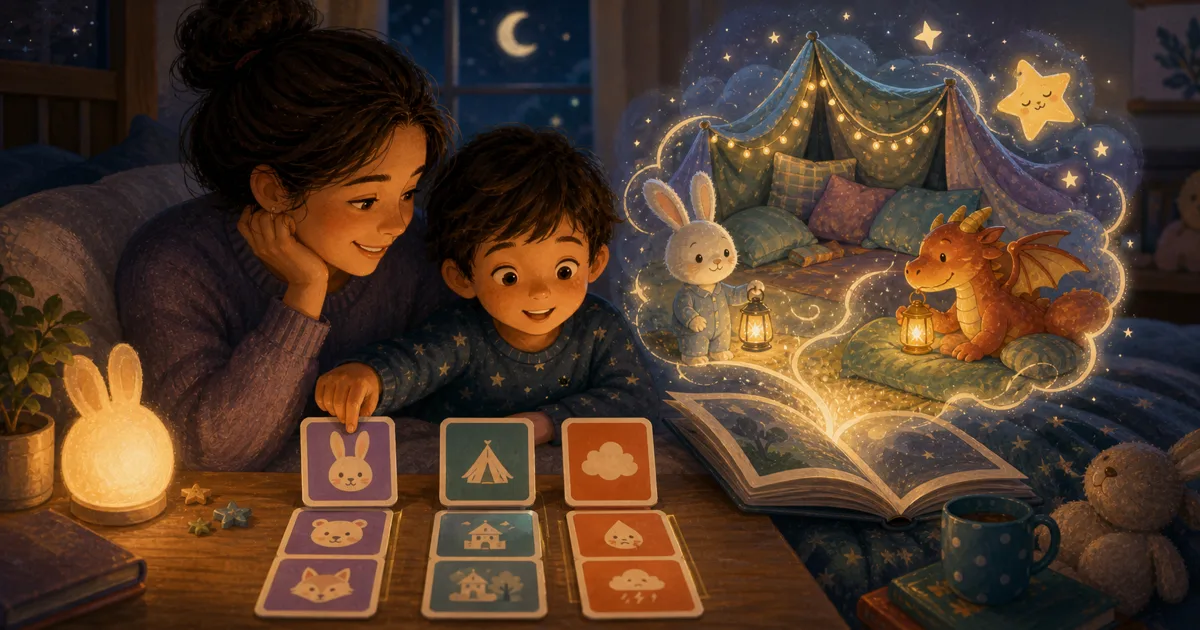
"A moon bunny in a blanket fort who loses the sleepy song."
This is probably too much for a sleepy room:
"A dragon battles ten villains across seven planets before sunrise."
Some kids love big adventures. But at bedtime, a smaller story gives you a clearer path back to lights out.
Our bedtime story prompts for kids guide has a repeatable formula for keeping the idea soft.
The best AI bedtime stories start with the child
The most meaningful generated story is often not the most polished one.
It is the one where your child recognizes their own idea.
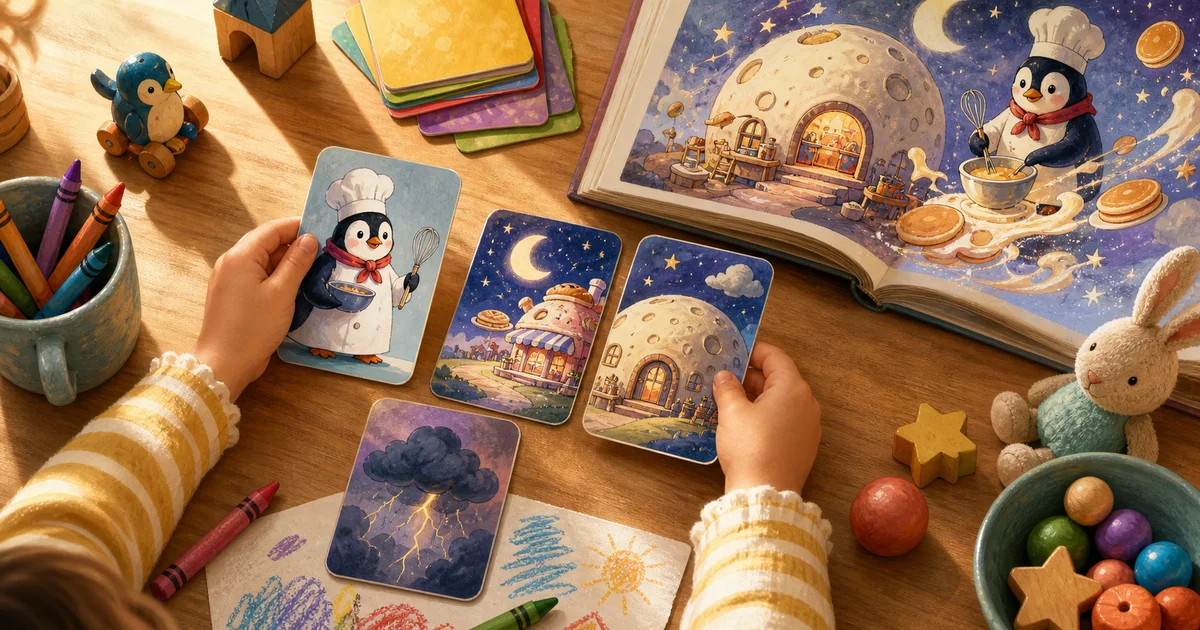
Maybe they said the bunny should be purple. Maybe they added the family dog. Maybe they wanted the moon to have a bakery. Those details are small, but they change the feeling of the story. It becomes something they helped make, not just something served to them.
That is one reason voice can be helpful. A child who cannot type a prompt can still say:
- "A dinosaur looking for pajamas"
- "A robot who cannot stop yawning"
- "A tiny train that brings blankets to stars"
In Storybox, that spoken idea becomes the seed for an illustrated story. Then the family can read it aloud together.
A simple bedtime prompt formula
Use this structure:
A character + a cozy place + a tiny problem + a soft ending question.
Try:
| Piece | Example |
|---|---|
| Character | A sleepy dragon |
| Cozy place | A moon library |
| Tiny problem | The night-light floated away |
| Ending question | What helps the dragon feel safe enough to sleep? |
Now turn it into one sentence:
"A sleepy dragon in a moon library whose night-light floated away."
After the story is created, ask the ending question as you read. That keeps the story interactive without opening a brand-new adventure.
How to keep AI bedtime stories from becoming more screen time
The screen should have a job.
For bedtime, that job might be: help the child make one story, then help the family read it.
Try this routine:
- Let your child say one short prompt.
- Read the finished story aloud together.
- Pick one favorite page.
- Ask one soft question.
- Stop there.
That last step matters. If the tool immediately becomes "make another, make another, make another," the bedtime value disappears.
Stories have endings for a reason. Parents need those endings too.
For a broader screen-time framework, read positive screen time for kids or our blog guide on what positive screen time means.
When Storybox fits bedtime, and when an old favorite is better
Storybox works best for bedtime when the prompt is short and personal.
Good prompts sound like:
- "A blanket monster who just wants a lullaby"
- "A fox who follows fireflies to bed"
- "A teddy bear who cannot find the quietest pillow"
- "A moon bakery that bakes dream cookies"
The app can turn that idea into illustrated pages, but the bedtime moment still belongs to the family. You can read slowly, pause on a picture, use a soft voice, and decide together whether the story becomes a favorite.
Some nights, though, the better choice is the book your child already knows by heart. New stories are not always the goal. If your child is overtired, anxious, or asking for the same familiar ending, repetition may be exactly what bedtime needs.
That is the Storybox fit: AI can help create the story, but the child and grown-up make it feel like bedtime.
Parent questions
Are AI bedtime stories good for kids?
They can be useful when they are short, child-led, and read together with a grown-up. They are less helpful when they become an endless stream of content right before sleep.
What should an AI bedtime story be about?
Choose a cozy character, a safe place, and a tiny problem. Keep the ending gentle. A sleepy dragon looking for a night-light is usually a better bedtime shape than a huge adventure.
Can Storybox make bedtime stories from my child's idea?
Yes. Storybox is a kids story app that turns a child's spoken idea into an illustrated story families can read together.
Should we use a new AI story every night?
Not necessarily. Some nights are for old favorites. Some nights are for a new idea. A healthy routine can include both.