AI story ideas for kids are getting attention because they solve a very ordinary problem.
Children have big imaginations. Parents have tired evenings. Teachers need quick warm-ups. Grandparents want something fun to share. Everyone likes the sound of a story that can begin quickly.
The interest makes sense.
But the family value is not in AI producing endless ideas. The value is in helping a child find one idea they care about, then turning it into something worth reading together.
That is the gap Storybox is trying to fill.
A simple routine
Use AI story ideas as a spark, not the whole fire.
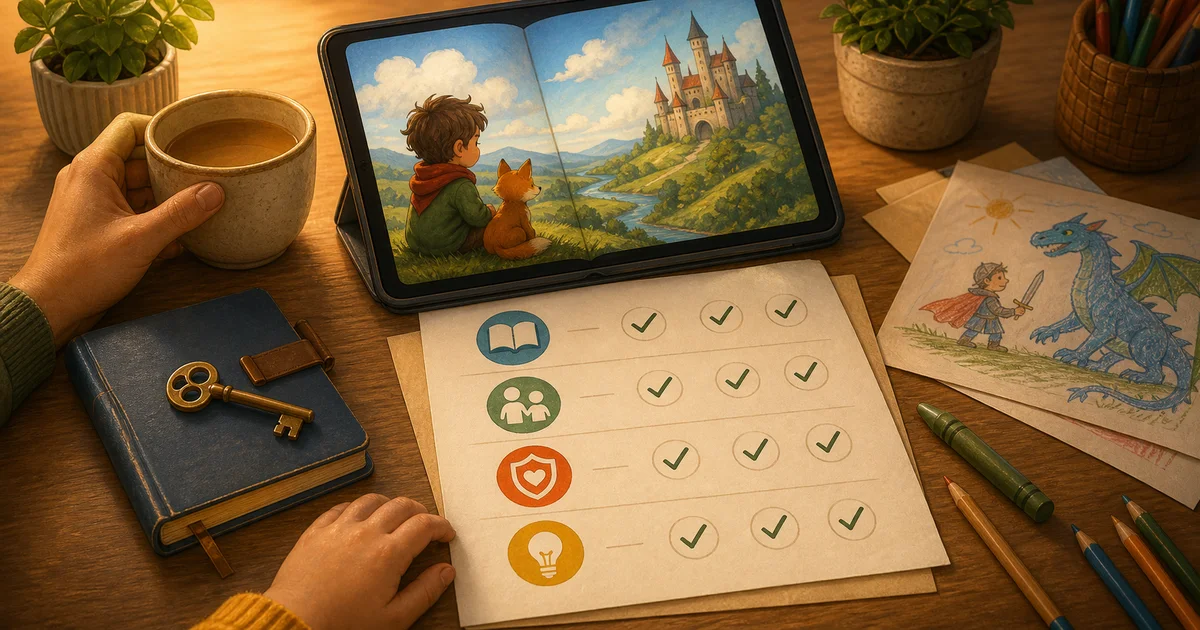
The strongest family routine is:
- Choose one simple idea.
- Let the child add one detail.
- Turn it into a short story.
- Read it aloud together.
- Save or extend only the stories your child actually likes.
For a practical prompt bank, use AI story prompts for kids. For a tool overview, see AI story generator for kids.
Why AI helps with the blank-page moment
The hardest part of making up a story is often the first ten seconds.
Your child may want a story, but not know where to begin. You may want to help, but your brain may be busy with pajamas, dishes, or the next school form that needs signing. A quick AI story idea can lower the pressure in that moment.
The trick is not to let the tool own the whole story. Let it offer a first spark, then hand the steering wheel back to your child.
That is the parent-centered question:
How do we use this technology so the child still feels like the storyteller?
That question is more specific, more trustworthy, and more aligned with what Storybox actually does.
Start with moments, not topics
The best story idea depends on the family moment.
Bedtime needs something different from a waiting room. A classroom needs something different from a grandparent call.
Try choosing the moment first:
| Moment | Better AI story idea |
|---|---|
| Bedtime | A sleepy fox looking for the quietest star |
| Waiting room | A backpack that keeps hiding snacks |
| Classroom | A pencil detective solving a library mystery |
| Grandparent call | A cookie jar that opens into a moon kitchen |
| Rainy day | A puddle that turns into a tiny ocean |
Now the idea has a job. It is not just "make something whimsical." It fits the room you are in.
Let your child customize one piece
One customization is usually enough.
Ask:
- What animal should be in it?
- Where should the story happen?
- What silly thing should go wrong?
- Should it be sleepy, funny, or brave?
- What real detail should we borrow?
If your child says, "Make it about our dog in a pancake castle," use that.
The personal detail is what makes the story feel like theirs. AI can help shape the pages, but the spark came from the child.
For more on personal details, read personalized stories for kids.
Five AI story idea patterns parents can reuse
1. The tiny problem
Give a character a small, solvable problem.
Examples:
- A dragon whose kite is afraid of heights
- A bunny who misplaces the moon's blanket
- A turtle who cannot find the library card
Tiny problems are good for younger children because they feel playful instead of overwhelming.
2. The familiar object becomes magical
Pick something in the room and give it a secret.
Examples:
- A lunchbox with a tiny weather system inside
- A blanket that becomes a map
- A spoon that wants to join a marching band
This works because the story begins in your child's real world.
3. The favorite animal gets a job
Kids often know the animal first.
Examples:
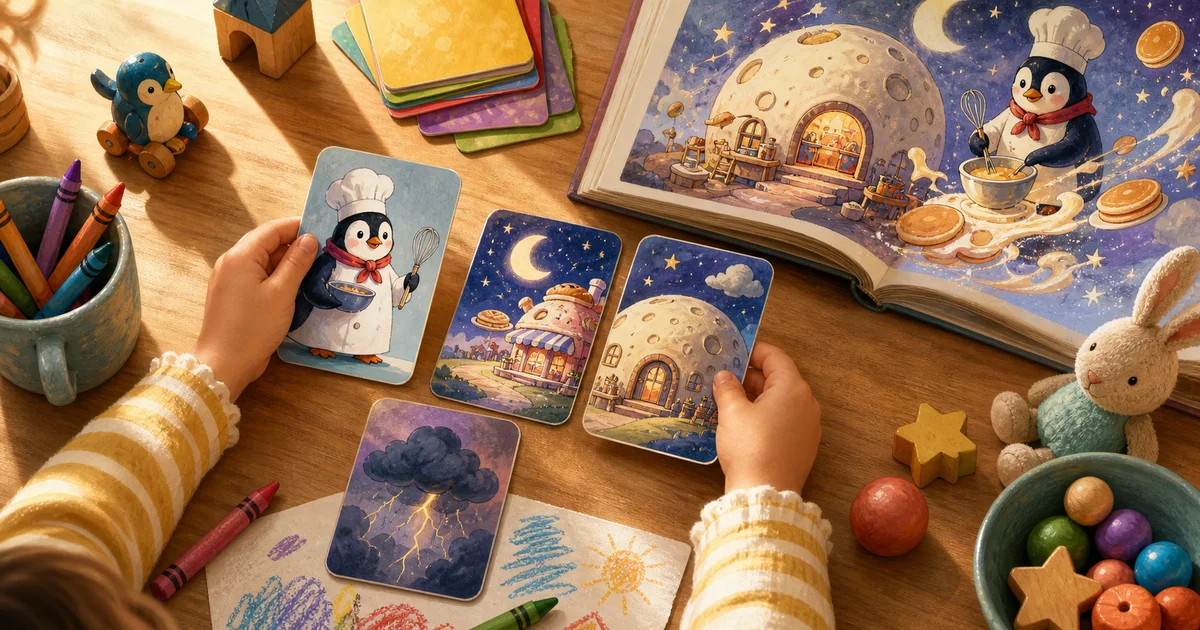
- A penguin chef
- A fox mail carrier
- A crab bus driver
- A cat astronaut
The job gives the animal something to do.
4. The place has a surprise
Choose a setting and make one thing impossible.
Examples:
- A library where books trade endings
- A bakery on the moon
- A school bus that drives through clouds
- A blanket fort with a tiny elevator
Settings are useful because they give the story pictures before the plot is clear.
5. The emotion stays gentle
Use stories to play with small feelings.
Examples:
- A shy robot practicing one joke
- A nervous dinosaur going to picture day
- A brave bear asking for help
Keep it light. If a child is dealing with something heavy, the story can support a conversation, but it should not replace the grown-up care they need.
How Storybox turns an idea into a reading loop
Storybox is a story maker for kids that starts with a child's spoken idea.
That matters because a lot of kids can tell a story before they can write one. They can say the strange part. They can add the family detail. They can decide whether the dragon is sleepy or dramatic.
Storybox turns that prompt into illustrated pages. Then the family reads.
The loop is simple:
- child idea
- illustrated story
- read-aloud
- save favorites
- make another when the family wants one
That is a better hook than "AI makes stories fast." The real promise is that AI helps a child create something they want to read.
A soft CTA for parents
If your child has a story idea tonight, keep it short.
Ask for:
- one character
- one place
- one tiny problem
Then use Storybox to turn it into pages.
AI may be the starting hook, but the moment parents remember is usually smaller: a child pointing at a page and saying, "That was my idea."