Personalized stories for kids are strongest when they feel like they could only belong to one child.
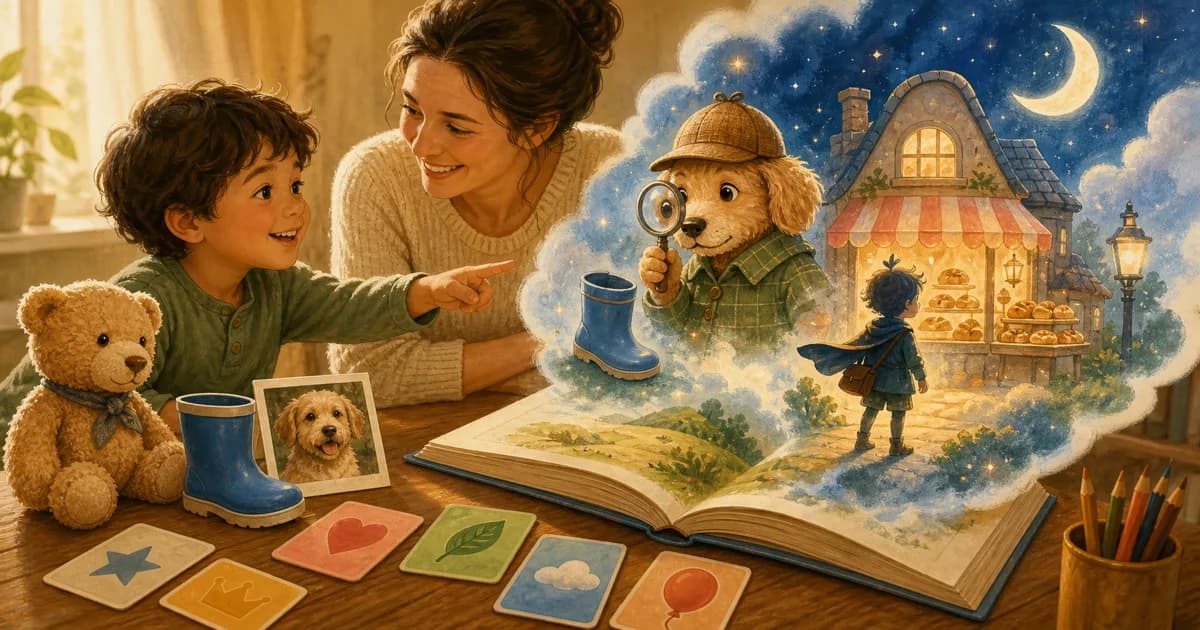
That does not mean the story needs a full biography, a complicated plot, or a long list of personal facts. Most of the time, one or two familiar details are enough: the rain boots by the door, the dog who always steals socks, the stuffed bear that sits near the pillow, or the bakery your child invented last week.
The short answer for parents is simple: use details your child can recognize, keep the problem small, and let the story leave room for reading together. A personalized story should feel specific, but still safe, flexible, and easy to enjoy again.
What makes a story feel personal?
A story can use a child's name and still feel generic. A story can avoid names completely and feel deeply personal.
The difference is usually not the label. It is the connection between the story and the child's own world. Kids notice when a story remembers something they said. They notice when a favorite animal returns. They notice when the character has the same tiny worry, joke, or question they had at dinner.
That is why personalized stories for kids work well when the prompt starts with a concrete detail:
- A favorite toy
- A pet or pretend pet
- A familiar place
- A repeated joke
- A small fear made gentle
- A character your child keeps inventing
- A favorite color, snack, or weather
Those details do not need to explain your child. They only need to give the story a handle your child can hold.
Better personalization is usually smaller
Parents sometimes feel pressure to make a personalized story elaborate. They want the child to be the hero, the setting to be accurate, the lesson to be meaningful, and the ending to land perfectly.
That can turn story time into homework.
Small personalization is easier and often more charming. Instead of trying to write a whole story about your child, try making one detail matter. Maybe the hero carries the same yellow umbrella your child loves. Maybe the dragon needs help finding a missing library card. Maybe the moon bakery serves the exact strawberry muffins your child requested at breakfast.
The detail becomes a signal: this story listened.
Storybox is built around that kind of starting point. A child can speak one idea out loud, and the app turns it into illustrated pages families can read together. The child does not have to type a full story, and the parent does not have to build a perfect prompt.
A simple prompt formula
When you want to create personalized stories for kids, this formula is usually enough:
A familiar detail + a character + a tiny problem.
Here are a few examples:
| Personal detail | Better prompt | Why it works |
|---|---|---|
| Blue rain boots | A dog detective finds one missing blue rain boot outside a moon bakery. | It uses a real object, but keeps the adventure playful. |
| Favorite stuffed bear | A stuffed bear learns how to help a sleepy train find its station. | The toy becomes useful without needing a big conflict. |
| Grandparent's kitchen | A tiny chef in Grandma's kitchen bakes cookies that tell bedtime jokes. | A familiar place becomes a cozy story setting. |
| Family pet | A cat who thinks she is a pirate searches for the quietest treasure in the house. | The pet detail gives the story personality. |
| A repeated joke | A robot keeps saying the wrong silly word at a library for dragons. | The child's humor becomes part of the plot. |
Notice that none of these prompts need private information. They are personal because they are familiar, not because they reveal too much.
Details to use carefully
Personalized does not have to mean overly specific. In fact, the best family prompts often avoid details that are too identifying or too emotionally loaded.
Good details for a story:
- A favorite toy or imaginary character
- A pet's first name or a pretend pet
- A general place, like "Grandma's kitchen" or "our backyard"
- A favorite kind of weather
- A funny object, snack, or color
- A gentle bedtime problem
Details to think twice about:
- Full names
- School names
- Street addresses
- Exact schedules
- Private family situations
- Anything your child would not want shared with someone else
This is not about making story time feel serious. It is about keeping the prompt light. A toy, animal, color, or made-up place is usually enough to make the story feel like home.
Let the child choose the one detail
If your child freezes when you ask, "What should tonight's story be about?", make the question smaller.
Try asking:
- "Should the story have a dragon or a dog?"
- "Should it happen in a bakery or on the moon?"
- "What one object has to be in the story?"
- "Should the problem be missing socks or noisy pancakes?"
- "Who should come back from yesterday's story?"
Two choices are easier than a blank page. A single detail is easier than a full plot. Once your child picks one thing, the rest of the story has somewhere to begin.
This is also helpful for younger children who have big ideas before they can write them down. They can still author the first spark. A grown-up can guide the prompt, and the finished story can become something to read aloud together.
If you want more prompt structure, our guide to bedtime story prompts for kids uses a simple character-place-problem pattern that works well with personalized details.
Personalization can support rereading
Parents often look for new story ideas because bedtime gets repetitive. But children frequently enjoy repetition, especially when the story feels like theirs.
A personalized story can become a favorite because it has a point of recognition. The child remembers choosing the dog detective. They remember the blue boot. They remember that the bakery was on the moon. When the same story comes back another night, it does not feel stale. It feels familiar.
That is one reason saved stories matter. In Storybox, families can keep the stories that land, return to them at bedtime, and share trusted reading links with family members when that makes sense. A grandparent does not need to be in the room to read the story a child helped invent.
For the bedtime side of this, our article on personalized bedtime stories for kids explains why small child-made details can make the first page easier to start.
How Storybox fits
Storybox is a kids story app for families who want the child to help create the story, not just consume one.
The app starts with a spoken idea. That matters because many children can imagine a story before they can write one comfortably. A prompt can be as short as "a tiny dragon in a moon bakery" or as specific as "our dog becomes a detective and finds my blue rain boot."
From there, Storybox creates illustrated pages families can read aloud, save, and revisit. The story still benefits from a grown-up nearby: someone to help choose the prompt, read the finished pages, ask questions, and decide whether the story is worth keeping.
If you are comparing tools, the Storybox approach is meant to keep the child's idea at the center. It is useful for families who want create your own stories energy without asking a tired parent to invent everything from scratch.
Personalized stories without making bedtime bigger
Personalized stories can be exciting. Bedtime usually needs the opposite.
The trick is to personalize the details, not the intensity. Choose soft settings, small problems, and endings that settle. A missing blanket is better than a world-ending quest. A sleepy dragon is better than a battle. A quiet bakery is better than a chase through seven planets, at least when the lights are already low.
Try prompts like:
- A tiny owl helps a blue boot find its matching friend.
- A stuffed bear opens a moon bakery that only serves sleepy cookies.
- A dog detective finds the quietest sound in the house.
- A blanket fort becomes a library for tired dragons.
- A rain cloud learns the lullaby your child made up.
These are still personalized. They are just personalized for the moment you are in.
A quick checklist for parents
Before creating a personalized story, ask:
- Is the detail familiar to my child?
- Is the problem small enough for bedtime or quiet reading?
- Does the prompt avoid unnecessary private information?
- Can the character come back in another story?
- Will this be fun for a grown-up to read aloud?
If the answer is mostly yes, the prompt is probably ready.
If the answer is no, simplify it. Pick one object, one character, and one gentle problem. That is plenty.
Frequently asked questions
What are personalized stories for kids?
Personalized stories for kids include familiar details from a child's life, imagination, or routine. That might be a favorite toy, pet, place, joke, or character. The goal is to make the story feel connected to the child without turning the prompt into a long personal profile.
Does a personalized story need to use my child's name?
No. A name can be sweet, but it is not required. Many stories feel more personal when they use a child's own idea, favorite character, or familiar object instead.
What details should I avoid?
Avoid details that are unnecessarily identifying or private, such as full names, school names, addresses, exact routines, or sensitive family information. A pet, toy, color, favorite place, or made-up character is usually enough.
Can personalized stories help when my child does not know what to ask for?
Yes, if you make the choice small. Offer two characters, two places, or two tiny problems. Children often find it easier to choose between playful options than to invent a whole story on the spot.
How can I make a personalized story calmer for bedtime?
Use familiar details with gentle stakes. Choose a cozy setting, a small problem, and a soft ending. If the story becomes a favorite, save it and read it again instead of creating something new every night.
Start with one detail
If you want to try personalized stories tonight, ask your child for one tiny detail that must appear in the story.
Not the whole plot. Not a lesson. Not a perfect beginning.
Just one detail.
Then let that detail matter. A blue boot can start a mystery. A stuffed bear can solve a problem. A dog photo can become a detective. The story feels personal because your child can point to the page and know, "I helped make that."
That is a good place to begin.